Publications
Peer-reviewed publications
2023
- RS
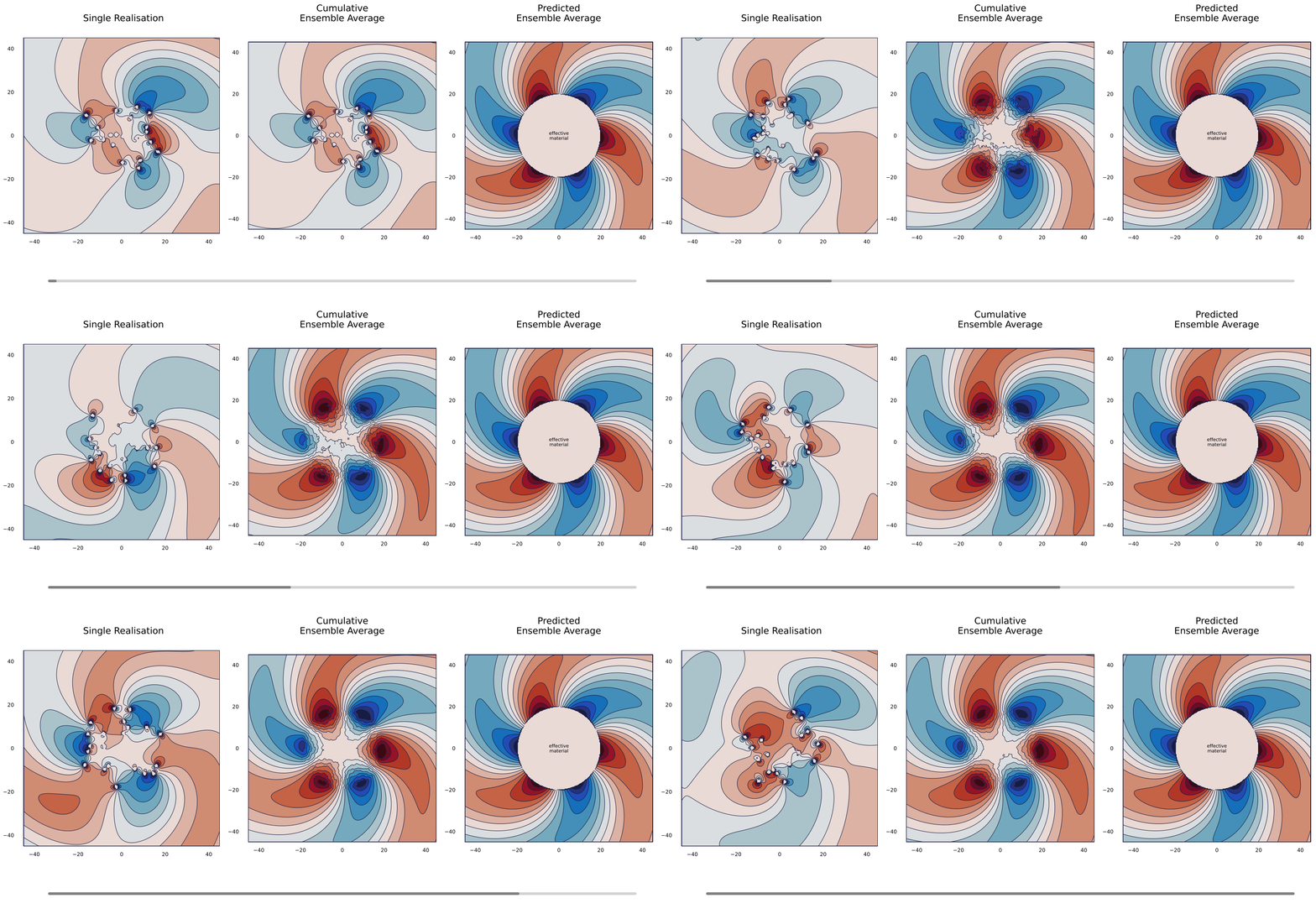 Effective T-matrix of a cylinder filled with a random 2D particulateKevish Napal, Paulo Piva, and Artur GowerProceedings A of the Royal Society, 2023
When a wave, such as sound or light, scatters within a densely packed particulate, it can be rescattered many times between the particles, which is called multiple scattering. Multiple scattering can be unavoidable when trying to use sound waves to measure a dense particulate, such as a composite with reinforcing fibres. Here, we solve from first principles multiple scattering of scalar waves, including acoustic, for any frequency from a set of two-dimensional particles confined in a circular area. This case has not been solved yet, and its solution is important to perform numerical validation, as particles within a cylinder require only a finite number of particles to perform direct numerical simulations. The method we use involves ensemble averaging over particle configurations, which leads us to deduce an effective T-matrix for the whole cylinder, which can be used to easily describe the scattering from any incident wave. In the specific case when the particles are monopole scatterers, the expression of this effective T-matrix simplifies and reduces to the T-matrix of a homogeneous cylinder with an effective wavenumber. To validate our theoretical predictions, we develop an efficient Monte Carlo method and conclude that our theoretical predictions are highly accurate for a broad range of frequencies.
@article{napal2023,
  title = {Effective T-matrix of a cylinder filled with a random 2D particulate},
  author = {Napal, Kevish and Piva, Paulo and Gower, Artur},
  journal = {Proceedings A of the Royal Society},
  year = {2023},
  publisher = {Royal Society},
}
2022
- JCPPoroelastic near-field inverse scatteringFatemeh Pourahmadian and Kevish NapalJournal of Computational Physics, 2022
A multiphysics data analytic platform is established for imaging poroelastic interfaces of finite permeability (e.g., hydraulic fractures) from elastic waveforms and/or acoustic pore pressure measurements. This is accom- plished through recent advances in design of non-iterative sampling methods to inverse scattering. The direct problem is formulated via the Biot equations in the frequency domain where a network of discontinuities is illuminated by a set of total body forces and fluid volumetric sources, while monitoring the induced (acoustic and elastic) scattered waves in an arbitrary near-field configuration. A thin-layer approximation is deployed to capture the rough and multiphase nature of interfaces whose spatially varying hydro-mechanical properties are a priori unknown. In this setting, the well-posedness analysis of the forward problem yields the admissibility conditions for the contact parameters. In light of which, the poroelastic scattering operator and its first and second factorizations are introduced and their mathematical properties are carefully examined. It is shown that the non-selfadjoint nature of the Biot system leads to an intrinsically asymmetric factorization of the scattering operator which may be symmetrized at certain limits. These results furnish a robust framework for systematic design of regularized and convex cost functionals whose minimizers underpin the multiphysics imaging indicators. The proposed solution is synthetically implemented with application to spatiotemporal reconstruction of hydraulic fracture networks via deep-well measurements.
@article{pourahmadian2022poroelastic,
  title = {Poroelastic near-field inverse scattering},
  author = {Pourahmadian, Fatemeh and Napal, Kevish},
  journal = {Journal of Computational Physics},
  volume = {455},
  pages = {111005},
  year = {2022},
  publisher = {Elsevier},
}
2021
- SIAMQualitative indicator functions for imaging crack networks using acoustic wavesKevish Napal, Lorenzo Audibert, Lucas Chesnel, and 1 more authorSIAM Journal on Scientific Computing, 2021
We consider the problem of imaging a crack network embedded in some homogeneous background from measured multistatic far field data generated by acoustic plane waves. We propose two novel approaches that can be seen as extensions of linear sampling-type methods and that provide indicator functions which are sensitive to local cracks densities. The first approach uses multiple frequencies data to compute spectral signatures associated with artificially embedded localized obstacles. The second approach also exploits the idea of incorporating an artificial background but uses data for a single frequency. The indicator function is built using a similar concept as for differential sampling methods: compare the solution of the interior transmission problem for healthy inclusion with the one with embedded cracks. The performance of the methods is tested and discussed on synthetic examples and the numerical results are compared with the ones obtained using the classical factorization method.
@article{audibert2021qualitative,
  title = {Qualitative indicator functions for imaging crack networks using acoustic waves},
  author = {Napal, Kevish and Audibert, Lorenzo and Chesnel, Lucas and Haddar, Houssem},
  journal = {SIAM Journal on Scientific Computing},
  volume = {43},
  number = {2},
  pages = {B271--B297},
  year = {2021},
  publisher = {SIAM},
}
2019
- Paris-SaclaySur l’utilisation de méthodes d’échantillonnages et des signatures spectrales pour la résolution de problèmes inverses en diffractionKevish NapalUniversité Paris-Saclay (ComUE), 2019
This thesis is a contribution to inverse scattering theory. We are more specifically interested in the non-destructive testing of heterogeneous materials such as composite materials by using acoustic waves. Monitoring this type of materials in an industrial environment is of major importance, but their complex structure makes this task difficult. The so-called sampling methods seem very promising to address this issue. We develop these techniques to detect the appearance of defects from far field data. The defects considered are impenetrable Neumann obstacles. We distinguish two categories of them, each requiring a specific treatment: cracks and obstacles with non empty interior.Thanks to the two complementary factorizations of the far field operator that we establish, we show that it is possible to approach the solution of the Interior Transmission Problem (ITP) from the data. The ITP is a system of partial differential equations that takes into account the physical parameters of the material being surveyed. We show that it is then possible to detect an anomaly by comparing the solutions of two different ITPs, one associated with measurements made before the defect appeared and the other one associated with measurements made after. The validity of the described method requires avoiding particular frequencies, which are the elements of the ITP spectrum for which this problem is not well posed. We show that this spectrum is an infinite set, countable and without finite accumulation points.In the last chapter, we use the recent notion of artificial backgrounds to image crack networks embedded in a homogeneous background. This approach allows us to design a transmission problem with the choice of the artificial background, for instance made of an obstacle. The associated spectrum is then sensitive to the presence of cracks inside the artificial obstacle. This allows to quantify locally the crack density. However, the computation of the spectrum requires data at several frequencies and is expensive in terms of calculations. We propose an alternative method using only data at fixed frequency and which consists in working with the solutions of the ITP instead of it’s spectrum.
@phdthesis{napal2019utilisation,
  title = {Sur l'utilisation de m{\'e}thodes d'{\'e}chantillonnages et des signatures spectrales pour la r{\'e}solution de probl{\`e}mes inverses en diffraction},
  author = {Napal, Kevish},
  year = {2019},
  school = {Universit{\'e} Paris-Saclay (ComUE)},
}
2018
- SpringerDetecting sound hard cracks in isotropic inhomogeneitiesKevish Napal, Lorenzo Audibert, Lucas Chesnel, and 1 more authorIn International Conference on Acoustics and Vibration, 2018
We consider the problem of detecting the presence of sound-hard cracks in a non homogeneous reference medium from the measurement of multi-static far field data. First, we provide a factorization of the far field operator in order to implement the Generalized Linear Sampling Method (GLSM). The justification of the analysis is also based on the study of a special interior transmission problem. This technique allows us to recover the support of the inhomogeneity of the medium but fails to locate cracks. In a second step, we consider a medium with a multiply connected inhomogeneity assuming that we know the far field data at one given frequency both before and after the appearance of cracks. Using the Differential Linear Sampling Method (DLSM), we explain how to identify the component(s) of the inhomogeneity where cracks have emerged. The theoretical justification of the procedure relies on the comparison of the solutions of the corresponding interior transmission problems without and with cracks. Finally we illustrate the GLSM and the DLSM providing numerical results in 2D. In particular, we show that our method is reliable for different scenarios simulating the appearance of cracks between two measurements campaigns.
@inproceedings{audibert2018detecting,
  title = {Detecting sound hard cracks in isotropic inhomogeneities},
  author = {Napal, Kevish and Audibert, Lorenzo and Chesnel, Lucas and Haddar, Houssem},
  booktitle = {International Conference on Acoustics and Vibration},
  pages = {61--73},
  year = {2018},
  organization = {Springer},
}